
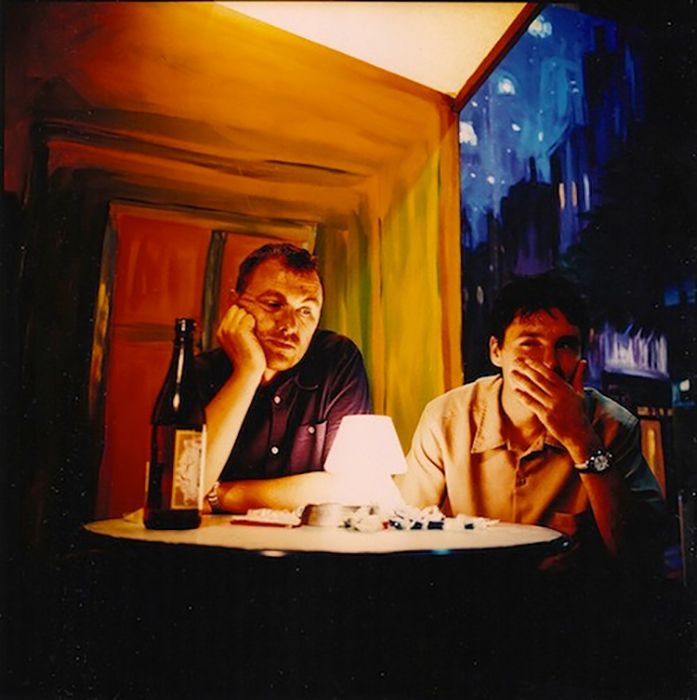
Last Friday night, after some sunset DJing at the Cider Box tap room in Bristol with Owain K of Innate, I spent several hours introducing him to the back catalogue of Fila Brazillia. I’d been bending his ear for days about the goodness in their catalogue and the uniqueness of their sound, so whacking on their albums in chronological order (or at least the first few – neither of us had the stomach to sit up all night to complete the set) seemed like a good way of proving my point.
I was right, as Owain was blown away by Old Codes, New Chaos, their still astonishingly good 1994 debut album, and vast swathes of the Hull duo’s 1995 follow-up, Maim That Tune. I was in my element, though shamefully I’d not given either album much attention for a few years, save for playing some of the many highlights in DJ sets. Listening again to those albums from start to finish was a great experience and did a lot to reaffirm my opinion that for too long Steve Cobby and David ‘Man’ McSherry’s killer catalogue had been slept on – at least by those who didn’t fall in love with them first time round.
Those albums are, in my opinion, windows into a time and place in British dance music that reflect wider trends and movements while sounding generally unique and distinctive – something few artists manage to achieve. Old Codes, New Chaos was recorded at different points over a four year period and reflects the colourful, loved-up giddiness of the time, boasting nods towards sunrise-ready deep house, kaleidoscopic Italian dream house, breakbeat driven dancefloor tackle, the sofa-bound vacant gaze of ambient house, and a whole heap of classic and contemporary musical influences.
It has numerous high points, many of which, such as ‘The Sheriff’, ‘Pots and Pans’, ‘Brazillification’ and 1991 debut 12” ‘Mermaids’, had first appeared as singles on the Pork Recordings imprint founded by Cobby’s then flat mate Porky. The real high point though – and a proper “experience” record when played at the right time – is ‘Fila Funk’, a genuine epic that evolves from saucer-eyed, bass-heavy breakbeat-meets-tactile deep house brilliance to Hendrix-sampling, percussion-heavy progressive house heaviness over the course of 19 mesmerising minutes. In hindsight, it’s not surprising that the album’s tracks proved popular within San Francisco’s wide-eyed party scene – and at the free parties run by crews such as Wicked – despite being made by two guys based on the UK’s chilly east coast rather than in sun-soaked California.
Maim That Tune, which appeared in stores a year later, shares some sonic similarities with its predecessor while offering more nods to the then blossoming ‘downtempo’ and chill-out scenes that emerged as a counterbalance to the increasingly fast, hard and hectic nature of much UK dance music. It, too, is a masterpiece; for proof, check the loved-up lusciousness of ‘Leggy’, the flanged stoner funk of ‘At Home in Space’, the exotic and percussion rich early progressive house of ‘Slacker’, the dubbed-out trip-hop of ‘Harmonicas Are Shite’, and the Bill Hicks-sampling deep breakbeat psychedelia of ‘6ft Wasp’. Oh, and ‘A Zed and Two Ls’, a bona-fide sunrise and sunset classic whose three-part slow-fast-slow structure is almost Reichian.
It has been heartening to see the renewed interest in their catalogue, particularly their early years. Running Back reissued ‘Mermaids’ last year (complete with bonus unheard versions of that and ‘Slacker’) and earlier this year International Feel offered up an EP led by Maim That Tune’s ‘Subtle Body’. Then there’s the small matter of Retrospective Redux 1990-2022 on Re:Warm, a career-spanning ‘best of’ that showcases some of many other gems the duo has released over the years, from the mutant downtempo jazz-funk (via Ibiza) wooziness of ‘Throwing Down a Shape’ (from 1997’s Power Clown) and the cheery funkiness of ‘Bumblehaun’ (originally released on 2002’s Jump Leads), to the heavy dub-goes-Americana shuffle of ‘Neanderthal’ (a digital-only release from 2004), and the “they’ve still got it” joy of the collection’s most recent recording, last year’s ‘Toro Del Fuego’.
It offers a great introduction to their catalogue – and a reminder of its varied gems for those who followed their fortunes back in the 90s and early 2000s – while inviting greater exploration of a body of work that is, by any marker, deep and broad. Really, you should listen to all of their albums, as well as the various collections of their remixes that were released by Kudos and their own TwentyThree imprint; their remix of DJ Food’s ‘Freedom’, featured on the first of these, is the one I’ve returned to the most over the years (and, for what it’s worth, played down at the Cider Box on Friday night). It is, in my opinion, genuinely magical (you can hear it below – although not credited to them on YouTube, it is the full nine-minute version of Fila’s fine revision).
Personally, my relationship with Fila Brazillia was igniting when I was at university in the late 1990s, a time when I was starting to learn my craft as a downtempo DJ, late-night ambient radio show host and wannabe music journalist. I was blown away by Power Clown and went backwards, hoovering up CDs of their previous albums. Later, as I started work as a music journalist, I had the opportunity to interview them; at different times since, there have been numerous other encounters, both in their home city of Hull and down here in Bristol.
It was a joy, then, to interview them once more last week – primarily about Retrospective Redux 1990-2022, but also about other albums, their early years, the scene (or lack of it) in Hull in the late 80s and early 90s, and much more besides. You can read a feature based on that interview right now on Juno Daily. You’ll also be able to hear some of it as part of an episode of Join The Future on Noods Radio; I’ll talk a little more about that before it airs in July.
If you want to start exploring the Fila Brazillia back catalogue, I’d suggest heading over to Steve and Man’s Bandcamp page – as well as all their albums and singles, it also includes some rarities and even a live recording of them, in their turn-of-the-millennium ‘band’ phase, at a festival in Japan back in 2000. You can find Steve Cobby’s solo material (including the astonishingly good I’ve Loved You All My Life album, recorded in tribute to his mum following her passing a couple of years ago) on his Bandcamp page.
Fila Brazillia: Retrospective Redux 1990-2022 is out now on Re:Warm

 JOIN THE FUTURE
Published by