
Over the years, I have spent rather a lot of time thinking about the perfect record to play as the sun is coming up. Anyone who has been to an all-night party in the countryside – whether a free party or a low-key, word-of-mouth ticketed one – will tell you that the moment the morning sun starts to peep over the horizon and turn the light a woozy shade of orange is a magical one. More often than not though, the musical accompaniment is less than ideal, with saucer-eyed and over-exuberant DJs reaching for tracks that are loud and energectic rather than groovy, tactile and loved-up.
I’ve been lucky to DJ in such environments a few times, and in the weeks and months beforehand I spent a lot of time thinking about the most appropriate “sunrise record”. Around a decade ago, I played alongside my long-time Bedmo Disco brother Five-Stylez at Barbarella’s Discotheque in Croatia during Soundwave Festival. “Barbs”, for the uninitiated, is an open-air club just outside Pirovac on the Adriatic coast – a space renowned as one of the best in the world for vibe, atmosphere, sound and scenery.
For some reason, we were scheduled to play the final 4am-6am set, allowing us the opportunity to drop that “sunrise record”. On that occasion, I played an edit I’d done of David Holmes’ remix of Sabres of Paradise’s ‘Smokebelch II’ at the “here comes the sun” moment, closing the set with Frontline Orchestra’s ‘Walking Into Sunshine’ – a conceptual choice of sorts since the lyrics talk about being on holiday (which a majority of the crowd, who had flown over from the UK, were) and walking by the sea (the waves of the Adriatic lap at the base of the wall at one end of the venue). The soundman – possibly the only sober person in the venue – was impressed by this choice; the remaining 6am Croatian stragglers less so.
A couple of years later, I was part of an extended crew who threw a secret, friends-and-friends-of-friends only weekend-long party up in the Brecon Beacons. On that occasion, the music ran continuously from 6pm on Friday until lunchtime on Sunday. Alongside my good pal Legendary Tone (a prolific maker of superb DJ mixes, which you can check out on his Mixcloud profile), I played the “sunrise slot” between 4 and 7am. As the sun appeared over the horizon, I dropped the Orb and Youth remix of ‘Staring at the Sun’ by Wendy & Lisa – a song whose lyrics expressly talk about seeing “a brand-new day”. It was a bit of a moment – at least for me and Tone.
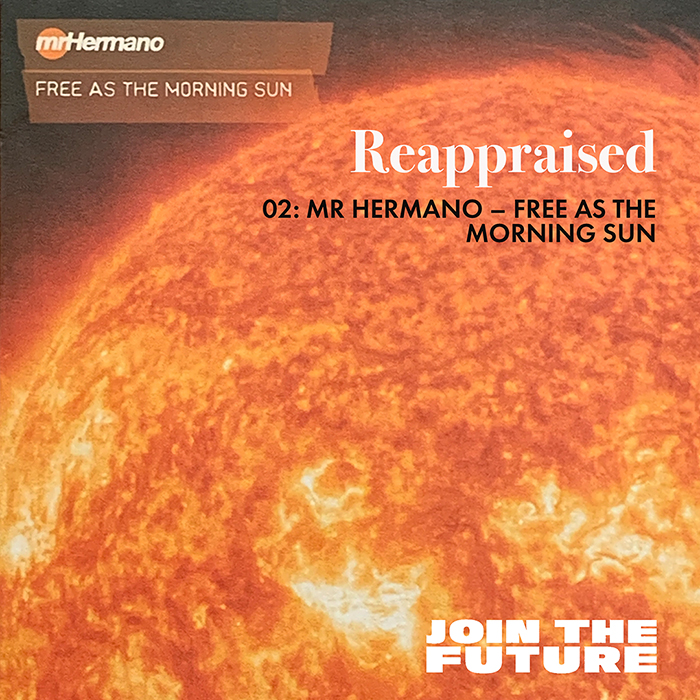
In hindsight, I’m surprised that on either occasion I didn’t reach for Mr Hermano’s ‘Free As The Morning Sun’. Released way back in 2001 as a teaser for the Mr Bongo/Disorient-signed duo’s superb album of the same name, it’s an unashamedly spiritually uplifting and gorgeously positive cover of the Carlos Santana composition of the same name. It was a popular record at the time, both with jazz-dance-minded and soulful house DJs, plus young ‘uns like myself who were just starting to explore the sun-soaked sounds of Brazilian musical culture.
My route into Brazilian music – bossa-nova, Samba, MPB, Latin fusion and so on – originally came via nu-jazz and (to a lesser extent) broken beat tracks made in tribute. There were a number of these on labels such as IRMA (see Nicola Conte’s ‘Bossa Per Due’ and Jet Sounds album), Far Out Recordings (which, I quickly discovered, also reissued vintage Brazilian music) and Michael Reinboth’s Compost Records imprint, which not only showcased Rainer Truby’s Latin-influenced nu-jazz trio (the other members being Peter Kruder and Christian Prommer), but also gave him the opportunity to showcase his favourite Brazilian and Brazilian-influenced jams on the excellent Glucklich compilations.
Mr Hermano were signed to Disorient, the Mr Bongo offshoot that tended to be a little more obviously dancefloor-focused than its parent label. The imprint’s early releases (late 1990s/early 2000s) included now legendary remixes of Brit-funk pioneers Atmosfear by Masters at Work, Francois K, Dimitri From Paris and the Idjut Boys, as well as Latin-influenced Japanese deep house and nu-jazz workouts licensed from Flower Recordings (an imprint still going strong today, albeit with an output that tends far more towards the Balearic end of the spectrum).
I also missed the earliest releases by Mr Hermano, an outfit comprised of multi-instrumentalist-turned producer Chris Fitzgerald and percussionist/producer Ben Mitchell. As well as running the Can Can recording studio in Brighton, Mitchell also operated under the alias Sao Benitez – a pseudonym presumably chosen to add a level of (fabricated) authenticity to his heavily samba and bossa-nova influenced productions. Not that his productions needed that; his love and knowledge of South American percussion, beats and musical culture was undeniable.
I didn’t know it back then, but by the time a new millennium rolled around, Mitchell was already a veteran. Alongside Steven Harper, he’d released a ton of records in the early-to-mid ‘90s under a variety of aliases (most notably Boomshanka and Da Boom Boys). These included formative progressive house outings on Cowboy Records and Junior Boy’s Own offshoot Jus’ Tracks, plus a string of 12” singles on their own Can Can label featuring vocalist Billie Godfrey.
The latter not only became Mitchell’s life partner, but also Mr Hermano’s go-to vocalist. When I started paying attention to Mr Hermano’s output in the summer of 2001, they’d already released two albums: 1999’s O Globo, a warm and inviting collection of percussion-rich Latin deep house workouts and the kind of infectious, drum-heavy South American style tracks tailor-made for the jazz-dance set, and Free As The Morning Sun.
That album was genuinely joyful, leaning more into Latin rhythms and instrumentation while stripping out most of the house influences that had been part of Mitchell’s work for the best part of a decade (he continued to occasionally lean into these in his Sao Benitez work – for proof, check the contemporaneous remixes of River Ocean’s 1994, Louie Vega-produced ‘Love and Happiness’ and the killer, percussion-rich ‘Drums and Vocal’ dub of Donna Summer cover ‘State of Independence’).
The album’s opener (and title track) is its most joyous moment by some distance. It was subsequently released as a 12” single and became something of an underground anthem that summer, with DJs of all persuasions frequently turning to it as a rushing, celebratory and arms-aloft end-of-night tune.
Naturally, Carlos Santana’s original version – a hazy and psychedelic affair first featured on the 1979 album Oneness (Silver Dreams-Golden Reality) – was rooted in the gentle shuffle and sprightly piano motifs of salsa, but the string-laden, wall-of-sound production slightly dampened song’s celebratory nature and hippy-ish lyrics. Warm, blissful and – in its own way – anthemic, but a little muddy and ripe for re-interpretation.
Mitchell and Fitzgerald’s answer was to foreground Latin percussion and pianos, as well as a deeper and heavier take on the original’s infectious double bass part, while adding fluttering flute solos and multi-tracked vocals (led, as ever, by Godfrey) that flit between jaunty, be-the-best-you-can verses and triumphant, near gospel choruses.
In the full-length album version form – which led the 12” EP – the track starts with a fluid bongo patterns and a multi-tracked rendition of the joyous chorus version, before dropping into a short piano riff and effectively re-starting the track. It’s a production choice that makes it perfect to “drop” rather than mix in. I’m also convinced that it would also make it even more impactful when played as the sun begins to rise above the distant horizon during a summer sunrise.
After that starting introduction, the song really settles in, with the loved-up and life-affirming vocals (especially the sing-along-at-the-top-of-your-voice chorus ones) becoming more prominent as the track progresses. By the time it concludes after seven and a half minutes, you’ll be in a genuinely happy place and want to hear it all over again.
In keeping with the format of most Mr Hermano singles, the duo’s superb original mix came backed with a handful of solid alternative takes. There’s a ‘Jazz Rooms Instrumental’ aimed squarely at the jazz-dance community (its title referencing Paul Murphy’s long running Brighton party of the same name) and a ‘DiSisco Edit’ that delivers a DJ-friendly interpretation built around percussion, pianos, bass, and those righteous chorus versions. Crucially, there was also a breezy, reverb-laden ‘Free-apella’ vocal version for adventurous DJs and producers who fancied making their own hush-hush bootleg remix.
Sadly, the various house versions that subsequently appeared – first by the largely forgotten Scumfrog and later Seamus Haaji and Paul Emmanuel – weren’t particularly good (to these ears at least). Some of the bonus cuts packaged with the Scumfrog remix – specifically the deliciously dreamy and spacey ‘Ambient Dub’ of ‘Hypnotista’ and the organic tribal house jazziness of ‘Talisman’ – are well worth checking though.
Following the release of ‘Free As The Morning Sun’, I headed down to the South Coast to research a piece on Brighton’s scene (or at least the dance music related end of it) as part of an IDJ magazine series profiling the music communities in different British cities. One of my first stops was the Mr Bongo office. Label manager Gav Smith introduced me to Mitchell in the CanCan Studio; I can’t for the life of me remember what we discussed, but I remember being impressed by the sheer number of percussion instruments on show and how genuine and enthusiastic Mitchell was. I then popped off to meet Tru Thoughts founder Rob Luis and various other local DJs and producers, while later in the day there was a very low-budget photoshoot outside Brighton Pavilion (I say low budget – it was me with a digital SLR rather than an actual hired snapper – the joys of tight-budget magazine production). It fills me with joy that all these years on, Mr Bongo and Tru Thoughts are still going strong.
As for ‘Free As The Morning Sun’ itself, the song’s infectious rhythms, sun-bright pianos and righteous vocals provided positivity and much-needed musical escapism for me in the weeks and months that followed the ‘9/11’ terrorist attacks in September 2001. Given that the world seems to going in a similarly dark direction again, perhaps it’s time to dust down the 12” again, whack it on the decks and let it distract us from the horrors of Trump 2.0, Ukraine, Gaza, climate change and the hundreds of other live issues threatening humanity in 2025.

 JOIN THE FUTURE
Published by