
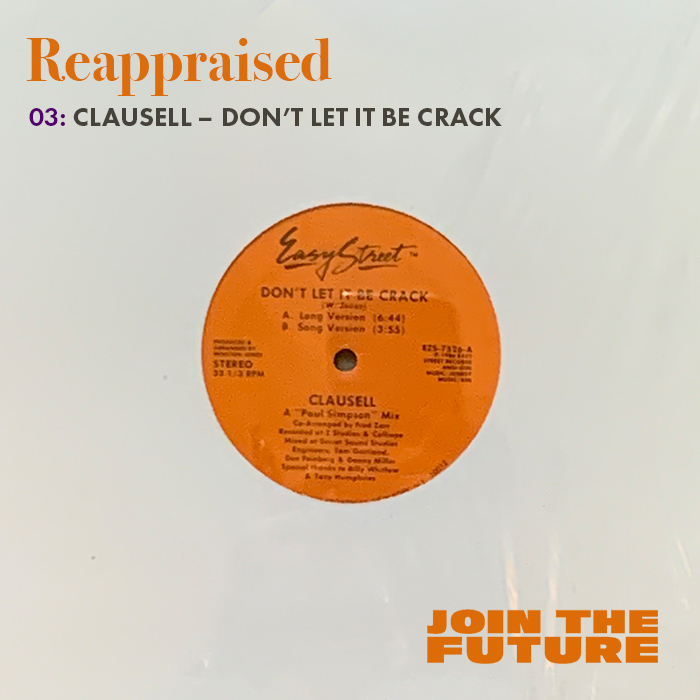
Artist: Clausell
Title: Don’t Let It Be Crack
Label: Easy Street Records
Released: 1986
Track listing: Don’t Let It Be Crack (Long Version) / Don’t Let It Be Crack (Song Version) / Don’t Let It Be Crack (Dub Version) / Don’t Let It Be Crack (Acapella Version)
A few years ago, I took a deep dive into one of the micro-genres that had long inspired me: post-boogie ‘proto-house’, or what should perhaps more accurately be called ‘formative garage-house’. I already had quite a few records, but I wanted to find more – and find out more about the people who made them. The result was a piece on the birth of garage-house – or at least the records that pre-dated what would become the NYC/New Jersey house sound – for RBMA Daily. You can still read that via the RBMA archive via this link.
The process of researching and writing the piece was a delight and included interviews with a veritable who’s who of key producers and DJs from the period, most notably Tony Humphries, Anthony Malloy of Temper fame, Paul Simpson and the late, great Boyd Jarvis (who, alongside friend Timmy Regisford, made the record that started the movement – Visual’s ‘The Music Got Me’. Incidentally, an almost complete transcription of my conversation with Boyd – one I am grateful I got a chance to have – is available to read via my mate Owain K’s Innate website.
That RBMA article ended up being quite controversial, in part thanks to the headline: ‘The Birth of House in New York City’. That headline was meant to refer to the origins of the New York and New Jersey style of house, dually shaped by the demands of dancefloors at the Paradise Garage and Club Zanzibar, but many took it as a sign that I and RBMA were trying to rewrite the history of house music to exclude Chicago. We were not.
In the piece I stated that this ‘proto-house’/early garage-house style was a separate, if contemporaneous movement that shared some sonic similarities to early Chicago house but was decidedly different – there were even quotes from interviewees saying similar (as well as confirming that there was a musical conversation of sorts going on between the two cities).
Unfortunately, some New Yorkers – mostly those who were devotees of Larry Levan back in the day – have long believed that house was ‘invented’ at the ‘Garage’. I have never thought this and had no idea they had been making this argument to Chicagoans for years, but in their eyes I’d written something that affirmed their view of musical history. As a result, the backlash from the Windy City (to the headline, at least – most didn’t read the article) was vicious, with Glenn Underground taking to Facebook to call me a “know-nothing white kid”. Ouch. Maybe he has a point, though it’s not for me to judge.
The experience didn’t dim my passion for that mid-to-late ‘80s New York sound, which like the UK’s later bleep techno wave (see the book that inspired this website etc.) owed much to the sonics and production techniques of Jamaican soundsystem culture. It may have been synth-heavy, soulful and informed by the post-disco boogie sound, but it was also relatively skeletal and groove-focused, with widespread use of dub-style effects (a good example, the ‘Momental’ mix of Subject’s ‘The Magic, The Moment’, produced by Jones and Simpson, can be found below).
There were two good reasons for that. Firstly, most of the young producers involved were self-proclaimed “garage kids” who wanted to make records that impressed their idol Larry Levan – someone with Caribbean heritage whose remixes at that time were frequently pretty darn dubbed out (his remixes for Gwen Guthrie, showcased on the Padlock mini-album and based on sessions recorded at Compass Point studios in Nassau, Barbados, being the absolute pinnacle of his productions). Secondly, some of these producers had Caribbean heritage too; Paul Simpson was born and lived for the first 10 years of his life in London, with an uncle who ran a reggae soundsystem in Brixton.
Simpson, alongside his regular collaborator Winston Jones and the engineer/keyboardist Fred Zarr, made some of the most awe-inspiring ‘proto’ records of the period, though it was Boyd Jarvis and Timmy Regisford, initially as Visual, who kicked the whole thing off. Between them, the quintet became in-demand producers and remixers at a time when record labels thought nothing of paying eye-watering sums in advances, remix fees and studio costs. By the end of the decade, Simpson had produced a string of hits for Adeva – arguably the first global garage-house star – and the whole crew had been paid a ridiculous amount to rework Chaka Khan tracks (alongside fellow NYC stars of the period Frankie Knuckles, David Morales, Tony Humprhies and Clivilles and Cole) for the Life Is A Dance remix album.
But it wasn’t all wall-to-wall dancefloor success and calls from the dance departments of major labels. They still had time to pursue their own projects, which tended to end up on sizable dance independents. It was to one of these, Easy Street Records, that Winston Jones, Fred Zarr and Paul Simpson took their “anti-drugs” record, 1986’s ‘Don’t Let It Be Crack’.
During the 1980s, America’s inner-city neighbourhoods – and black and Hispanic communities in particular – suffered through an increasingly bleak crack cocaine ‘epidemic’. New York was hit especially hard, with the Observer even sending a team of reporters to Harlem and Manhattan in 1987 to report on the drug’s prevalence and the dizzying levels of addition.
During the era of crack – described by the Observer as “the ultimate ‘80s drug” – the homicide rate within African-American communities increased dramatically, as did emergency hospitalisations and the number of children in foster care. The Reagan administration responded with a high profile “war on drugs” with especially harsh penalties for dealing and possession of crack cocaine, and a campaign to “just say no”.
The prevalence of crack cocaine within inner-city NYC neighbourhoods was undoubtedly widespread. NYC’s “club kids” – including those now established as makers of cutting-edge dance music – were not immune to it; after all, many were born, grew up and still lived within those very neighbourhoods. Many “garage kids” (as Paradise Garage regulars called themselves) ended up in the vice-like grip of addiction, leading some to lose almost everything. Some of the producers mentioned above were heavy users at different points in the 1980s, while others dabbled recreationally.
Issues surrounding hard drugs and their impact on African-American communities had long been reflected in music – Marvin Gaye’s ‘Flying High In The Friendly Sky’ on What’s Going On focused on heroin addiction, while crack and its impact of course featured heavily in the lyrics to ‘The Message’ by Grandmaster Flash and the Furious Five.
Clausell’s ‘Don’t Let It Be Crack’ fits neatly into this lineage, though it naturally lacks the profile of those classic cuts. There are numerous reasons for that, the biggest being that it was a record made by club kids, for club kids, in what was then a niche regional style (albeit one that also found favour in black clubs across the Atlantic).
‘Don’t Let It Be Crack’ was credited to its lead singer, soul man Clausell Hickenbottom – a vocalist who had previously released just one single, the seductive 1982 cult classic ‘Let Me Love You’. Yet he was merely the front man; the record was created by the NYC proto-house dream team of Winston Jones (who officially wrote and produced it), Fred Zarr (arrangement) and Paul Simpson (mixing).
The lyrics for ‘Don’t Let It Be Crack’, delivered with passion and oodles of soul by Hickenbottom, are ominous and to the point, warning of the “dangers lurking in the night” and – via group harmony vocals that sound like they were laid down by a choir of teenage girls – the drug’s highly addictive nature (“it will hold you tight, like a thief in the night, so don’t let it take hold!”).
This significant message is delivered over a track that bears all the hallmarks of Jones and Simpson’s production of the period: a prominent, undulating bassline of the sort used on Serious Intention classic ‘You Don’t Know’; effects-laden drum machine beats; moody synth washes; Fairlight-derived orchestral stabs; and bubbly electronic melodies.
In keeping with the excitement of the times and New York producers’ obsession with developing sampling technology, it also includes some stuttering, pitched-up vocal stabs (“Cra-cra-cra-crack!” etc) and other dated – but then cutting edge – studio trickery (it even includes short samples of dogs barking, for which we can probably hold Pet Shop Boys’ contemporaneous pop hit ‘Suburbia’ responsible – that or the sheer novelty of being able to sample shortish sounds using the pricey but pioneering Fairlight CMI music computer).
Like other proto-garage-house records of the period, the ‘Don’t Let It Be Crack’ 12” boasts a suite of mixes of variable quality. There’s the full-song, club-focused ‘Long Version’; the shorter, radio edit style, vocal foregrounded ‘Song Version’; a DJ tool style ‘Acapella Version’ featuring the reverb-laden lead and backing vocals; and a typically Simpsonian ‘Dub Mix’ which, like many of his alternate ‘versions’ of the era, sounds like it was created as a live desk mix, Jamaican dub style. Sparse, effects-laden and largely skeletal – albeit with slightly too excessive use of stabbing vocal samples – it is easily the strongest take on the track, though it still sounds like it needs a re-edit. If you dig the revivalist proto-house dubs of Mark Seven’s Parkway Records, you’ll feel right at home.
For some reason, Easy Street returned to the track in 1994, turning to production trio Jon Skinner, Luke Baldry and Mark Diprose for a suite of organ-powered “trad garage” (what we in the UK would have called ‘US garage’) reworks. Tougher and more polished, featuring many tropes of NY/NJ garage from the period, they arguably make better use of Hickenbottom’s impassioned and effortlessly soulful lead vocal. There are two dubs, too, with Ripe’s ‘tribal dub’ being particularly potent (in part because it sounds like a cross between Tony Humphries-style garage, British breakbeat house and the kind of warped, big room-ready fare being made and played by Danny Tenaglia and Junior Vasquez during the same period).
Assuming it was played at ‘the garage’ by Larry Levan – who, it should be noted, struggled with drug addiction and ultimately lost his career and life because of it – ‘Don’t Let It Be Crack’ was a record made by “garage kids”, to warn other “garage kids” of the dangers of a drug whose use was phenomenally widespread at the time. Judged in those terms, it’s a hell of a lot cooler than, say, any of the high-profile public information campaigns run in the US by then First Lady Nancy Reagan (and for that matter their UK equivalents, such as the BBC’s short-lived current affairs programme ‘Drug Watch’, whose appalling theme tune ‘Just Say No’ was sung by the cast of children’s school-based soap opera Grange Hill). In other words, it’s a fascinating time capsule.

 JOIN THE FUTURE
Published by