
Four and a half years have now passed since I received an email from the Assembly House Trust in Norwich asking if I’d like to present a lecture about ‘rave culture’ in East Anglia as part of their pandemic-era series of online events. It was that talk, entitled Of & By: Matt Anniss – Storm From The East: The Roots and Rise of Rave Culture in East Anglia, that inspired a number of articles, academic conference presentations and an ongoing PhD project at Southampton Solent University.
Back then, I only had the most basic grasp of the story of dance music in East Anglia – a genuinely hidden history (back then, at least – some of the story was later told in my 2022 DJ magazine piece on the same subject) and I’d failed to grasp the sheer scale and frequency of ‘pay-rave’ (IE unlicensed but ticketed) and free party activity in Cambridgeshire, Norfolk and Suffolk since the late 1980s.
The more I dug into it, the more I realised that there was a great history to documented and told. One of the many things that intrigued me – more so than the prevalence of hardcore, jungle and drum & bass in the region, which is unusual given the relative lack of Caribbean soundsystem culture compared to other parts of England – was how vibrant the rural and coastal rave scene was. Not only that, it has become culturally embedded; or, to put it more simply, free party culture never died in Norfolk, Suffolk and Cambridgeshire, or tailed off in the way that it did in some other parts of the country.
Of course, free party culture never died in the 1990s, as we’re sometimes told, but in most places it became the preserve of a relatively limited number of increasingly secretive crews dotted around the country. In East Anglia, rural countercultural events – specifically free festivals and revivalist medieval style ‘fairs – happened annually throughout the 1970s and early 80s, pre-dating the rave explosion of the turn-of-the-90s.
By the early 90s, raves were happening almost every weekend somewhere in the region. It was initially regular club promoters who tried their hand at running raves in forests, quarries, abandoned agricultural buildings and out of town warehouses, as well as on beaches, former airfields and farmers’ fields.
As those crews stepped away, dedicated free party collectives stepped up, weakening the link between existing urban dance music communities (for example in Kings Lynn, Cambridge, Norwich, Peterborough, Lowestoft and Ipswich) but creating a unique regional rave scene with its own distinctive characteristics. This, swelled by smaller, impromptu ‘DIY’ events and larger raves run in the region but organised by outsiders, created a scene that not only sustained, but also enjoyed additional peaks of activity in the 2000s and 2010s – much to the annoyance of the Police, local newspapers, and some local residents.
What happened in East Anglia – and to a lesser extent, continues to happen – has rarely been acknowledged, let alone documented or celebrated (though some active and former members of the EA rave community are attempting to do that in different ways, such as participant-led Facebook groups and DIY heritage projects). A few years ago, I met Aaron Trinder, director of the excellent Free Party: A Folk History documentary film and asked him whether he had come across the East Anglian rave scene during his research; surprisingly, he said ‘no’. As great as that film is, East Anglia is undoubtedly a glaring omission.
This, though, is perhaps not that surprising. As I explained (albeit in a fairly academic way) in this piece based on my DC23 conference paper presentation, there’s little or no research on dance music culture in rural regions, let alone free parties and pay-raves. In addition, East Anglia’s raves – however popular or well attended – were typically run by crews whose activities were all but unknown outside of the region (at least outside of the tight-knit networks that sustain free party culture in the UK and beyond).
There have been books about DIY Soundsystem and Spiral Tribe, collectives whose efforts to protest the 1994 Criminal Justice & Public Order Act were particularly high profile. To date, nothing exists that includes East Anglian crews like 2 Good, Proper Stuff, Kite High, Planet Yes, Unity Tribe, Brains Kan, Equality Cohesion and countless others who have thrown parties in the countryside (and on the coast) since 1989.
There is much that we can learn from what happened, rave-wise, in East Anglia between 1989 and 2019, such as how dance music culture took root in rural regions (historically, it tends to be framed as a uniquely urban movement), how the culture grew and became sustainable, the impact it had on young people in the region, and whether Cambridgeshire, Norfolk and Suffolk should be considered – and I say this speculatively – a kind of countercultural playground for ravers.
None of this is possible, though, without the input of those who attended, DJ’d at and organised pay-raves and free parties in the region. Little documentation exists – at least that you could use to write an extensive and detailed history – and what does is largely held by those involved. It is possible to make a timeline of raves that were reported on by newspapers (which are usually those raided and shut down by the Police), but that would only include a fraction of the events that have taken place since 1989. It also wouldn’t tell us what those experiences were like for those involved, what they meant, and the role of the communities that developed around the regional rave scene and individual free party collectives.
To those who created, participated and sustained rave culture in East Anglia, those experiences were in some cases genuinely life changing. They are the ones who should tell this story and shape the history that will be written down the line – not just in my PhD thesis, but also any books, exhibitions and documentaries that emerge down the line. It is their story to tell and I am grateful to anyone who has stepped forward already and done that.
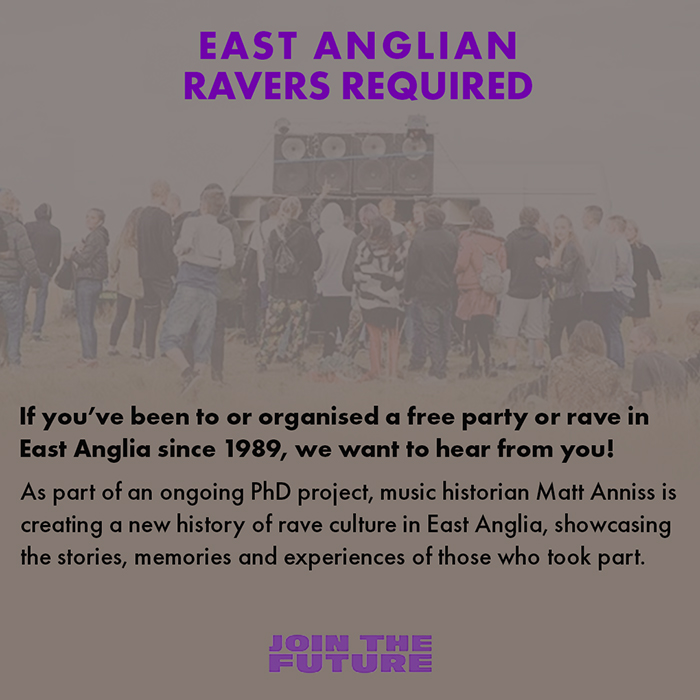
Today (Monday 7th April 2025), I have launched the first stage of what academics call “participatory research” on this PhD project. This takes the form of an anonymous online survey (questionnaire), where anyone who has at some point attended one or more raves in the region can share some of their experiences, give brief details of some of the raves they have attended and, if they so wish, put themselves forward to be interviewed. This is, of course, optional, but the more interviews I’m able to conduct later in the year, the more detailed and accurate the subsequent history will be.
If you are willing to fill in the survey, and I would really appreciate it, you can access it by clicking this link. It takes less than 10 minutes to complete. You can also find a rundown of the terms and conditions (basically info about how the info you provide will be stored and used, and your rights to withdraw from the research project at any point) via this dedicated page. The survey will be online until May 28, 2025.
In addition, I will be over in East Anglia promoting the survey, meeting contacts and delivering fliers – which feature a QR code which, when scanned, takes you to the survey – later this week. These are the events to look out for and attend if you’re close:
• Friday 11th April: Ordinary Lives, Everyday People? Pop Culture, Subculture & Social Change conference at the University of East Anglia
Entrance to this is free, but you have to register in advance. I will be presenting an academic paper based on my PhD research to date.
• Saturday 12th April: PhD research ‘drop-in’ session at PrimeYarc, Market Gates, Great Yarmouth
Taking place from midday until 2pm, this is a chance to ask me questions about the research, pick up fliers and get more information. You can listen to a talk I did, alongside local DJ Richie and host Jonathan P Watts, on this very website.
• Sunday 13th April: Join The Future presents Uncovering Hidden Histories: A Brief History of Rave Culture in East Anglia – talk at the Holloway, 19B St Lawrence Steps, St Benedict’s Street, Norwich
A brand-new lecture and book reading focusing on hidden histories, the importance of documenting them, and the story of rave culture in East Anglia. Head here for tickets and more information. It takes place between 1pm and 4pm, by the way.
If you have any questions about the research, feel free to contact me.
Excited to take part in the research? A quick reminder that you can find the online survey here.

 JOIN THE FUTURE
LikeLiked by 1 person
the best raves in east Anglia was the ones that had no trouble and run by ravers for ravers (Exdous) and (Badboy Fm) from 1986
LikeLiked by 1 person
hello
I raves in the 90s and DJ as well at Eclipse I was a resident
also played at and went to a lot of illegal parties
LikeLiked by 1 person